Many years ago when I was on the ROTC rifle team, my shooting fell into a slump. I was griping about my rifle when the sergeant grabbed my rifle, put a shot dead center in the bullseye, and then put three more through the exact same hole. He handed it back and said “it’s not the rifle.” A few months ago, I overheard someone say “I just can’t afford the kind of camera and lenses that the contest winners use, so I can’t compete with them.” As my sergeant told me, it’s not the camera.
Let’s look at a few facts about cameras and lenses. The latest and greatest cameras have enormous megapixel sensors, great autofocus systems, insanely high frame rates and maybe a few other features that make photography a bit easier. But the best camera in the world doesn’t take a great or even good photo without a good photographer behind it. If we’re honest with ourselves, we probably hold the camera back more than it holds us back. Yes, it’s a great feeling when you get the latest camera, but don’t expect it to make you a better photographer. In fact, your photography is likely to suffer for a while, until you learn all of the features and controls of the new camera. Before you run out and buy equipment, ask yourself if it will do something better that is essential to your style of photography. Also remember that some really great images have been made by those older cameras. They were good cameras in their day, and they didn’t become bad cameras just because a newer camera has come out.
As for the idea that your camera is keeping you from winning contests or making great images, it’s just not true. A newer camera might let you make larger prints, but realistically most of our images are shared on the web in one form or another, usually on a monitor with 1920 X 1080 pixels, or maybe 2560 x 1440. And most contests like the PSC require images to be entered as 1920 x 1080 Jpegs, which is only 2.1 megapixels. So even if you have the latest 50 or 60 MP camera, you have negated most if not all of the newer camera’s advantages.
I decided a to do some experimenting and compare my current camera, a Canon 5D Mark IV which has 30 MP and was introduced in 2017 (oh no! I’m seven years out of date), to my first digital which was a Canon 30D which was released in 2006 and has an 8MP sensor. The 5D is a full frame camera, and the 30D is an APSC with a 1.6 crop factor.
When these articles are converted to PDF and sized for the newsletter, the resolution and quality of the images is seriously degraded. If you would like to read the article and see the images as I did, you can see this article on my website at this link.
https://mickeyrountree.smugmug.com/Articles/Basic-Photography-Series/
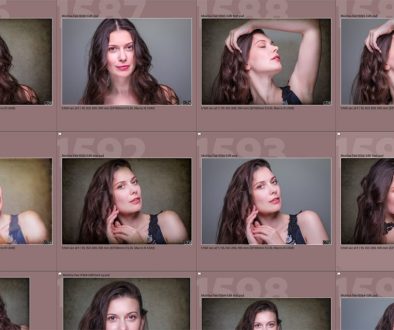
I won’t claim that these are great images, or contest worthy, but can you really see a real difference at 1920 x 1080? Also the Canon 30D and 18-55mm kit lens can be bought used for $75-100, while the Canon 5D Mark IV 24-105mm can be bought for $3600. Can you see $3500 worth of difference between images? Also I’m not going to say which image was shot with which camera.
These two images have just my basic portrait editing done in Lightroom and skin retouching in Photoshop.


By the time I add some additional touches like adding a texture, there is even less of a noticeable difference.


Just to make this comparison as equal as possible all of processing for the pear still life was done in Lightroom only. Lighting was the same and I used a 50mm lens on the 30D image and an 85mm lens lenses to maintain the same shooting distance and perspective.


Does this mean I want to ditch my 5D and go back to the 30D? No way. Can I make usable images with the 30D? I used to in 2007 and if I had to I still could. Would a new $3600 Canon R5 or $5500 R3 and a couple of new lenses make me a better photographer? Probably not, but for sure I’ll never know until I win a lottery.
While we’re talking cameras, I have to admit that in the past I have been known to disparage “cell phone pics”. That was primarily because we are constantly barraged by bad cell phone pictures in social media. But in the last few years the quality of cell phone photos has increased tremendously. With just a few tweaks a good photographer can produce a really good image. You’ve probably seen 16 x 20 images in our gallery that were taken by a cell phone, but you wouldn’t have known unless you were told. I’m pretty sure some of the images in the last PSC annual contest were shot with cell phones, and some may have won ribbons.
I just got through judging the annual contest, and I can say for a fact that I couldn’t tell a Canon from a Nikon, from a Sony; I couldn’t tell a DSLR from a mirrorless; a 20 MP camera from a 50 MP, and I couldn’t tell a top of the line manufacturer’s lens from a cheap third party lens. What I could tell was the difference between good and bad composition, good and bad lighting, good and bad processing, sharp and poorly focused images, and good and bad concepts.
So if you win the next billion-dollar lottery jackpot, by all means go buy the latest camera (or two and a bunch of new lenses). In the meantime, realize that the camera doesn’t make the photographer, the photographer makes the camera. Or as the saying goes, 95% of cameras are better than 95% of the photographers.