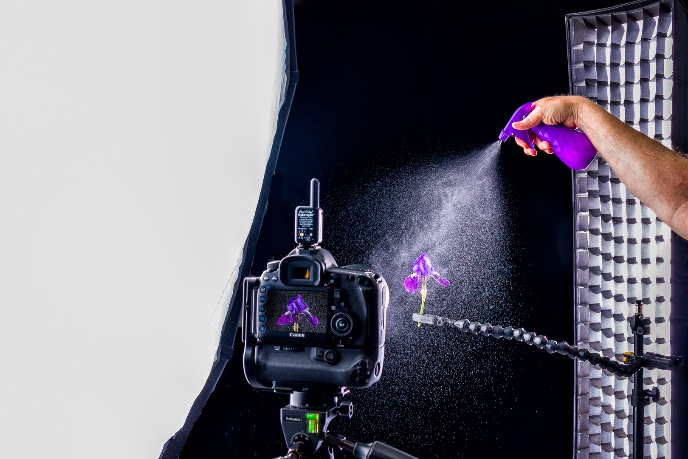
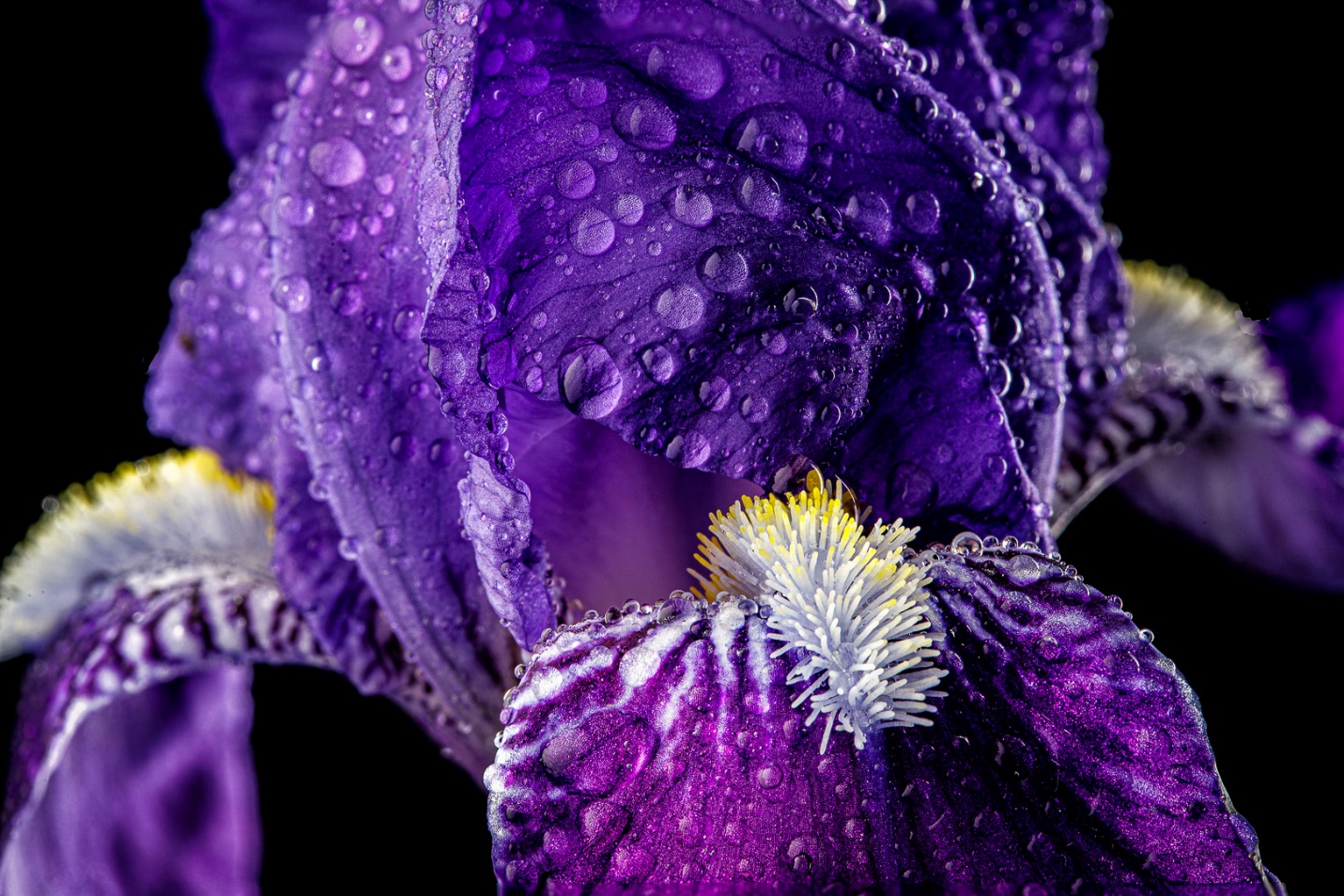
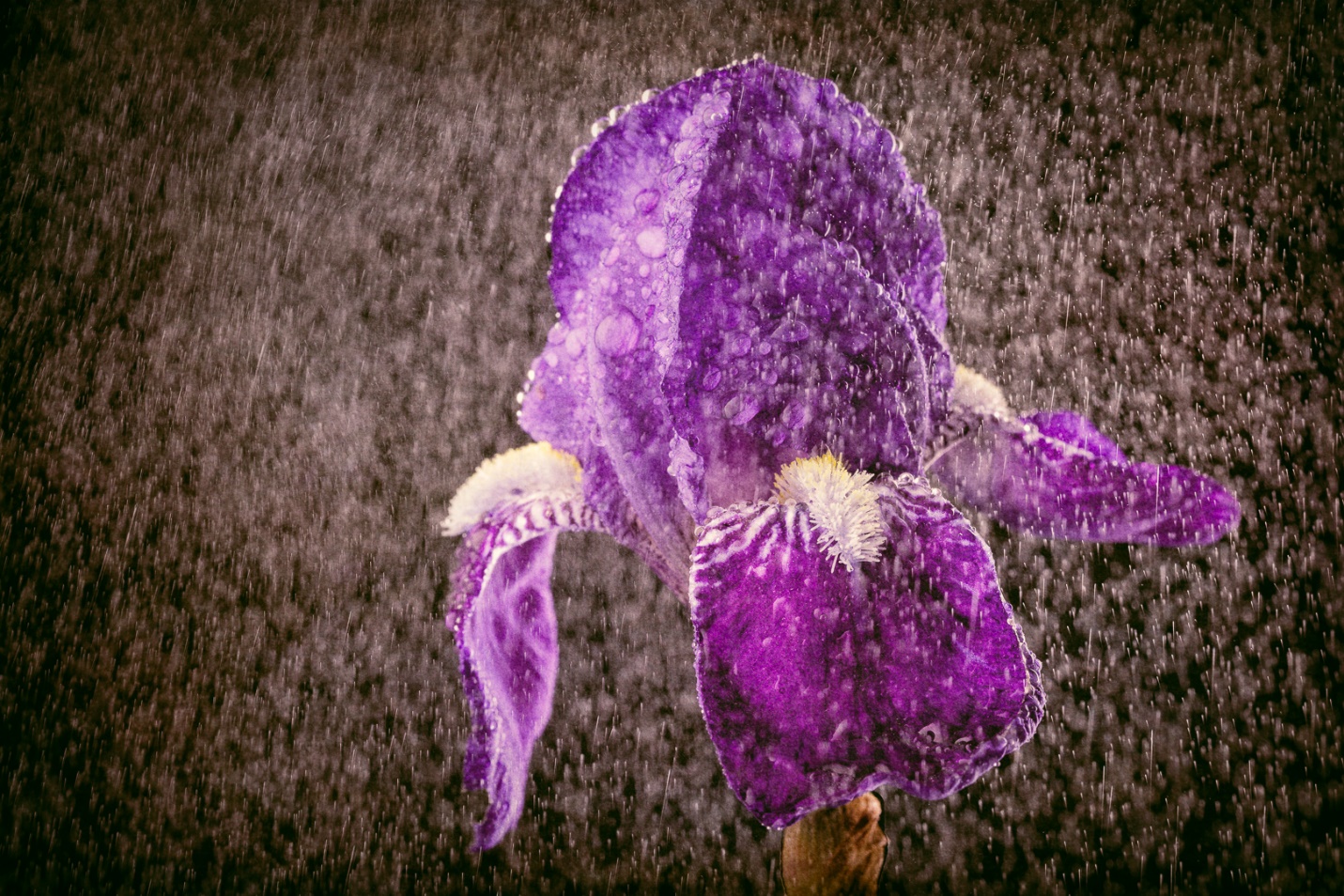
I found a nice purple iris in my yard, and decided to bring it into the studio to photograph it. I almost always spray some water on my flowers for extra interest and texture, but today I decided to shoot as I sprayed to get a rain effect. While I got some shots I liked, there was one unexpected problem that I’ll talk about in a minute.
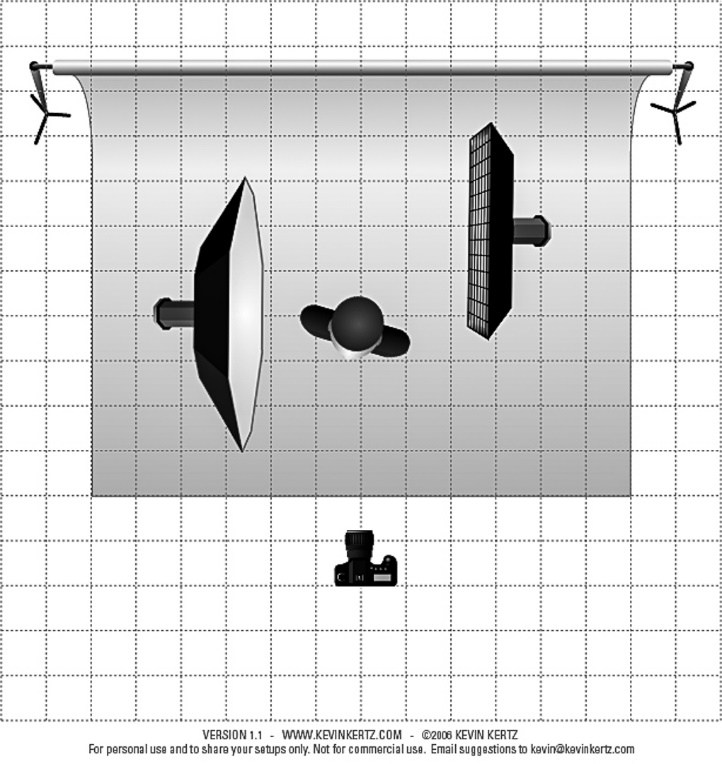
I shot with my Canon 5D Mark IV and 100mm f2.8 IS “L” Macro lens. My bloom was held with a Wimberly Plamp which makes positioning the flower easier and precise. I lit this with a large Octabox camera left, and a strip light with a grid behind the flower and camera right. This is very similar to one of my favorite portrait lighting setups. The indoor rain droplets came from a two small spray bottles; one gave a fine mist and the other a coarser spray. Exposure was ISO 200, 1/125 sec and aperture varied between f/16 and f/22 for deep depth of field.
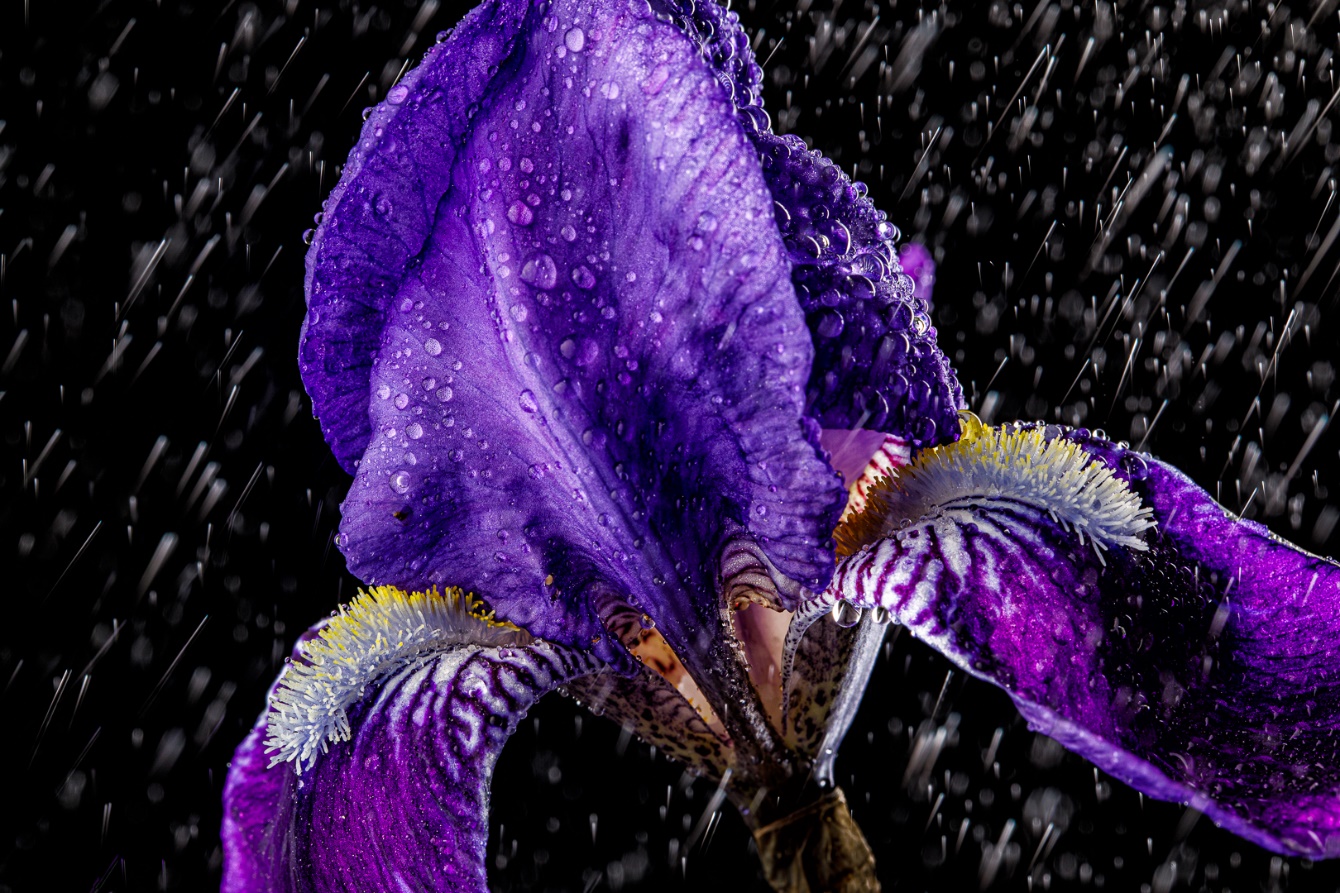
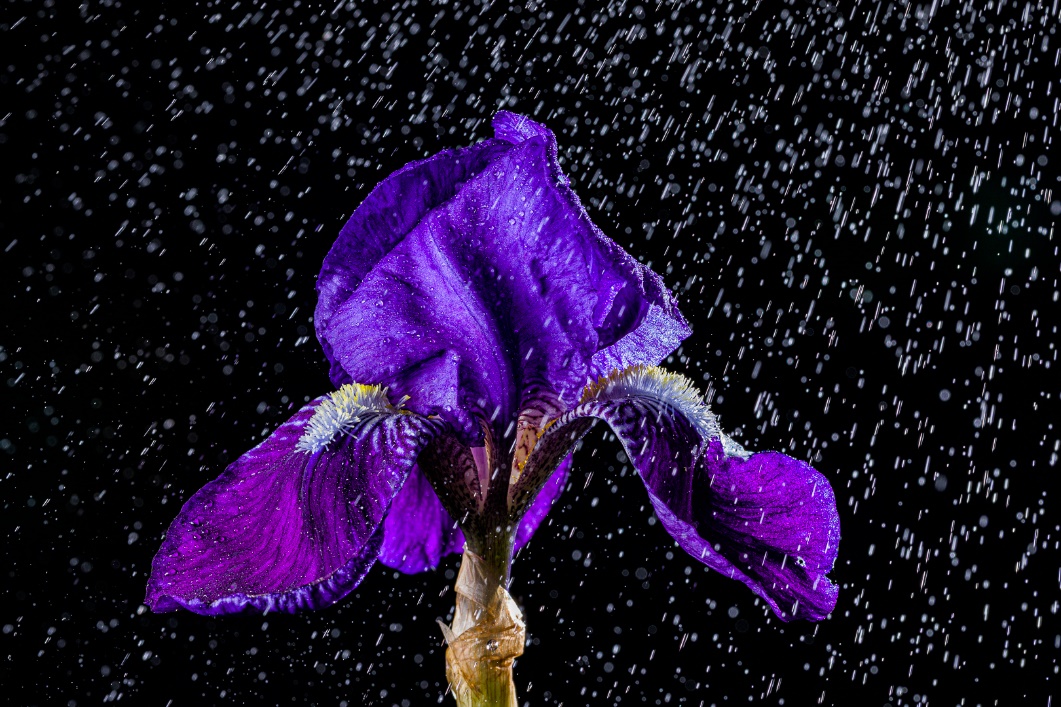
Here is one of the first images I took. I like it, but if you look at the raindrops closely, you’ll see the problem. In nature, and how we perceive them in our minds, water drops fall with the fat part down, and the trailing tail of motion blur going up. The raindrops in my shot look just the opposite and that almost makes them appear to be going up rather than falling downward.
There are several reasons this happened, and there are a couple of possible fixes that I may shoot later if I’m not feeling lazy. First, many people assume that the speed of a flash firing is so fast it will freeze motion. But different flashes have different flash durations. Generally, at full flash power like I was using, the flash duration is longer. Also on a studio strobe like I was using, there is an initial discharge where most of the light is produced, giving us the bright fat part of the drop, but then it falls off gradually from there leaving the motion streaks below our drops. The streaks weren’t from ambient light in the studio because the room lights were off. Also studio strobes use what is called front curtain synch. So the strobe fires as soon as the first curtain starts to move so any movement during the time the shutter is open appears to blur in front of the drop, rather than behind it.
So how do I fix it? First, I could buy a really large, powerful (and expensive) strobe with a very short flash duration. That’s not happening; have you noticed the price of gas and groceries lately? The second, cheaper fix is to shoot using speedlites rather than a studio strobe. Speedlites have a shorter flash duration, especially at lower power, and they don’t have the slow fall off of a studio strobe. Also most camera and speedlite combinations allow for rear curtain synch, so the flash doesn’t fire until the shutter is closing, so the streaks have already occurred behind the drop before the flash lights it.
So there must be a downside (or two or three) or I would have just started with speedlites. The first down side is the limited power of speedlites. I was shooting at ISO 200 and f/16 or f/22. To do that with speedlites, the light would have to be very close, I’d probably be at a much higher ISO and larger aperture (not what I needed for depth of field), and I probably couldn’t get enough power to use a softbox. Again at full power the speedlite would have a longer flash duration also. It would be difficult to get the light quality, good depth of field and the quality of a low ISO with speedlites, but I may do some experimenting later. And the biggest downside is that speedlites don’t have modeling lights, so placement is trial and error.
Generally, my style in the studio has been clean, sharp, graphic images like the one below.
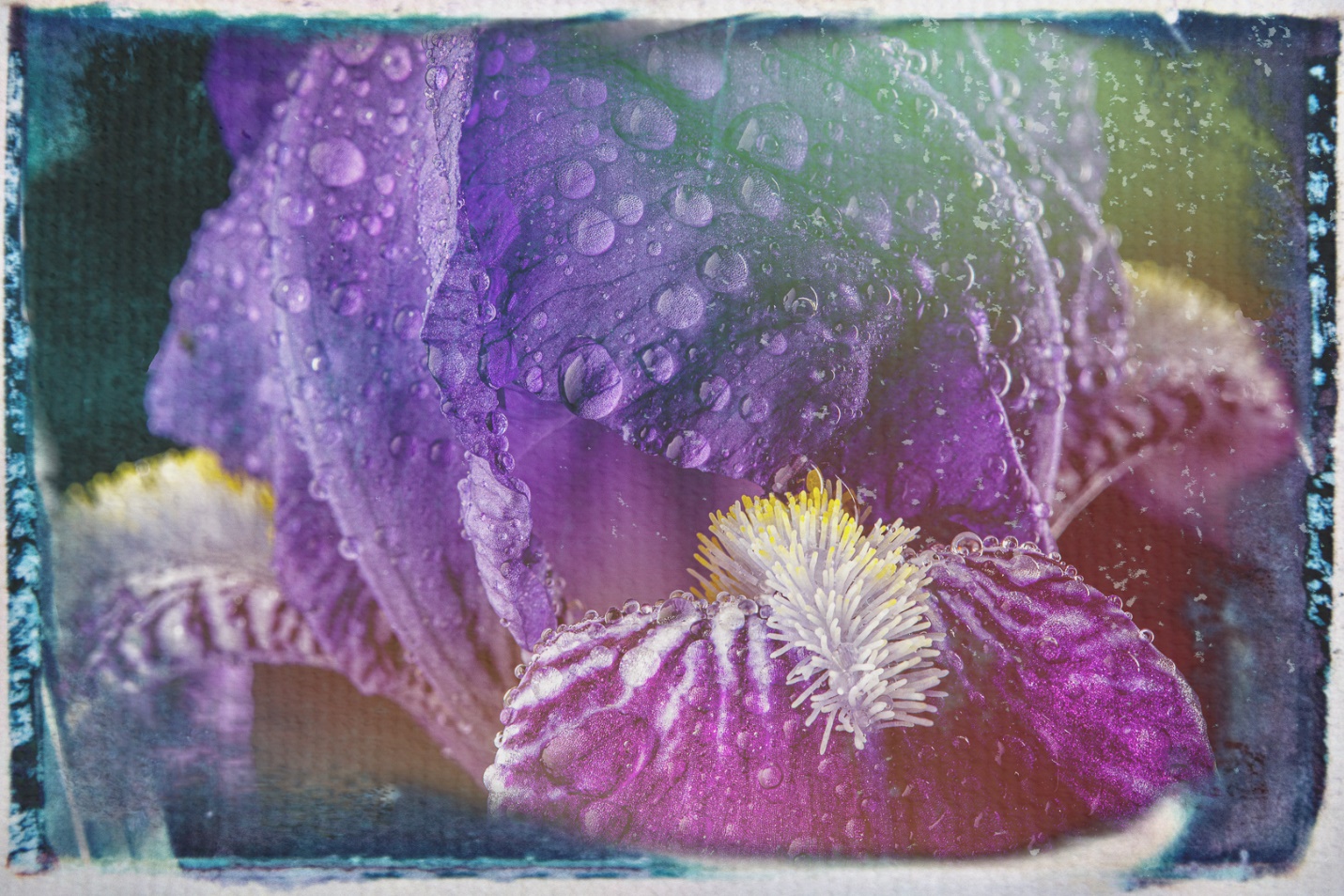
Lately I’ve been experimenting more and more with textures, color grading, and other filters to produce a less realistic and perhaps more artistic look. It’s still a learning process and I’m not fully comfortable with it yet, but I’m getting there.
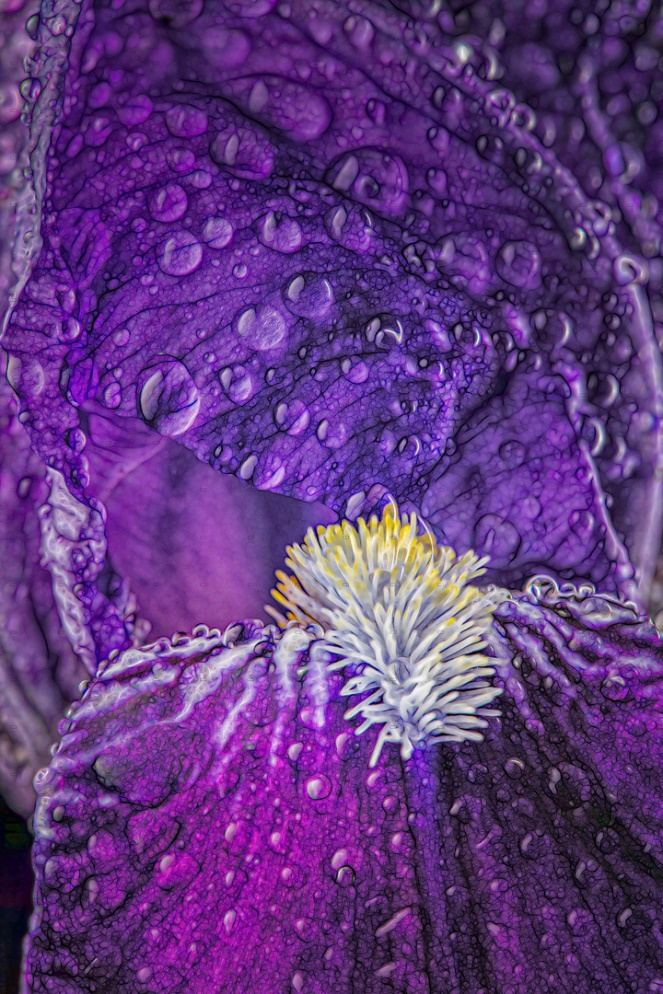
This last image required focus stacking four images because of the very shallow depth of field produced by extreme magnification. Even f/22 couldn’t provide enough depth of field for the look I wanted. And if I’m being honest, I had to go back and reread my older article on focus stacking because I haven’t had to use it in over a year.
BONUS
I knew I wasn’t going to sleep tonight unless and until I got out some speedlites to see if they really would change the look of the rain. I had a very small (about 5X7 in) and inexpensive softbox that goes directly on a speedlite. I placed this about 4 inches from the iris for two reasons. First by placing it so close it was still relatively large in relation to the flower and produced a fairly soft light. Second by placing it so close, I was able to shoot at f/22 at ISO 400 at only 1/16 power, which makes for much shorter flash duration. I used a second speedlite with a grid, also at 1/16 power behind the flower and camera right to backlight the flower and “rain”.
So, did we learn anything? First, I already knew it, but now you know it too; I’d rather do photography than sleep. Second was a bit of a surprise to me; I was able to get my f/22 exposure by only going to ISO 400, and still only used 1/16 power on the flashes. That was important because of the short flash duration. Third, the speedlites really did produce less of a “tail” on the raindrops, and even where it did the drops don’t feel like they are rising up instead of falling down. Fourth, it matters how I sprayed. If I sprayed down on the flower with a slow squeeze, the drops were larger, and fell faster due to direction and weight. If I made a fast squeeze aimed more above the flower, the drops were smaller, lighter and didn’t fall as fast or blur as much.
I have been working with speedlites more and more, and other than the lack of modeling lights they can handle small jobs almost as well as studio strobes, if not better, as in this case.
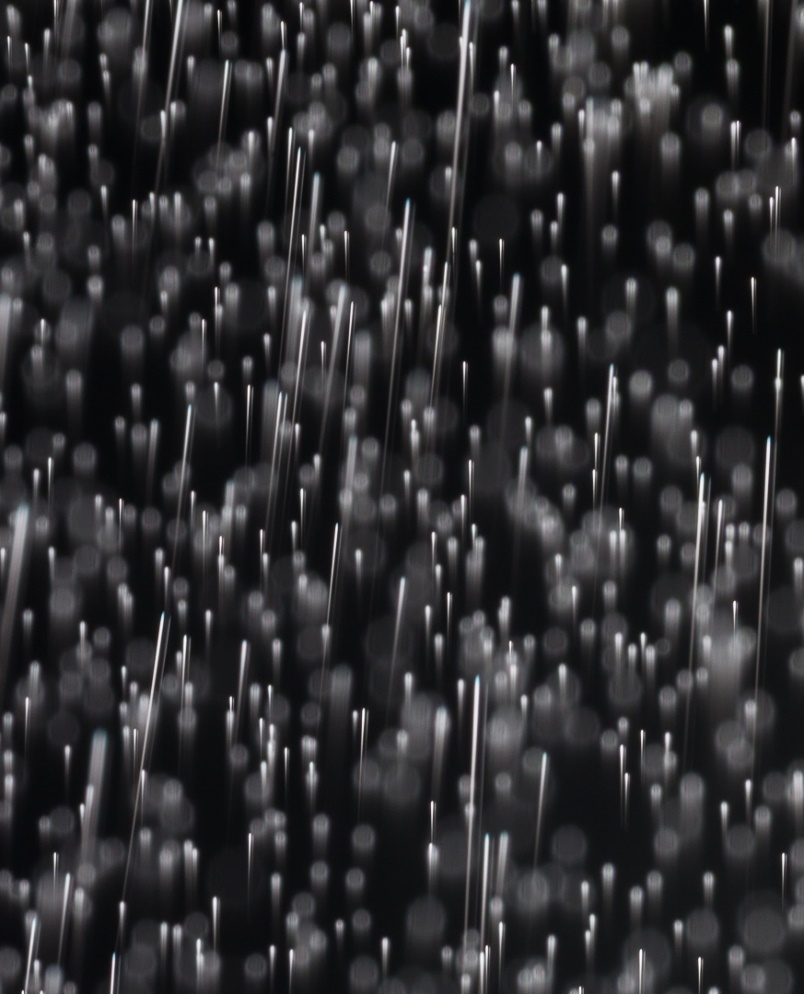
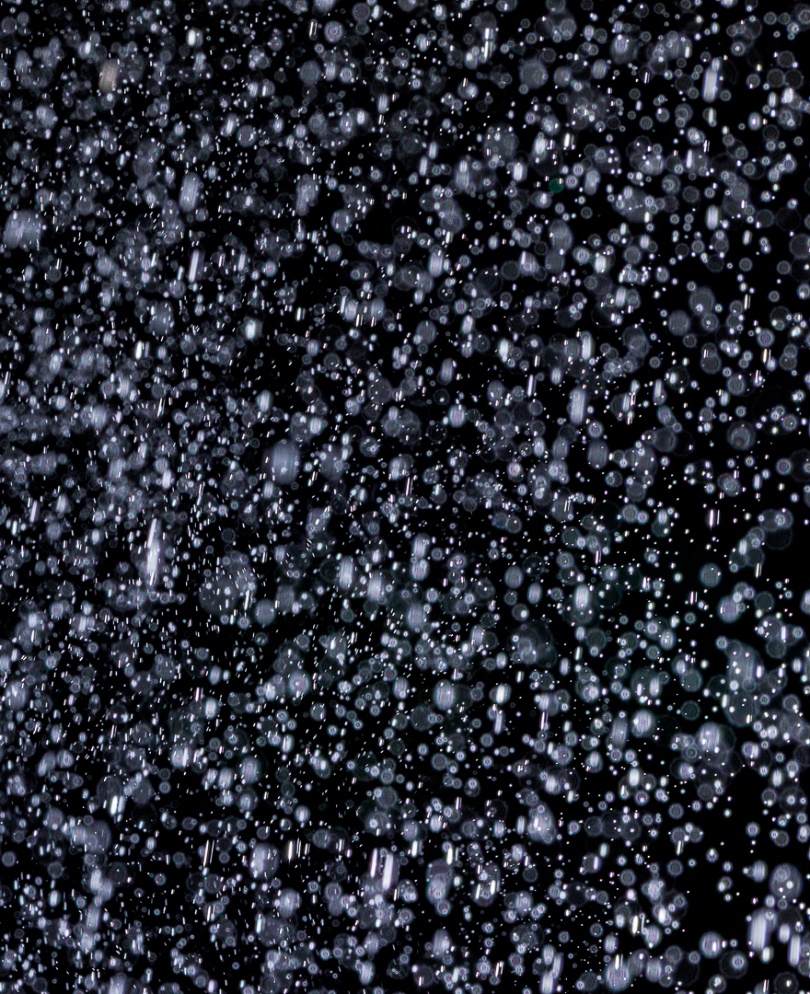
Here’s a detail of the rain shot by a speedlite. Notice the tails are almost nonexistent or very short due to the short flash duration. And the tails don’t taper and look like they’re rising.
Here a slow squeeze aimed downward produced larger drops and slightly longer tails.
Here a quicker spray aimed above the flower produced small drops with almost no tails.